
Our History
Construction During the Fascist Era
1937 - 1943
In 1937, Benito Mussolini chose Mount Soratte as the site for an air-raid shelter designed to ensure the survival of the Fascist government in the event of widespread devastation in the capital.
The original project envisaged the construction of more than 14 km of interconnected tunnels. However, the complex that survives today consists of a maze of approximately 4 km of walkable tunnels, all on a single level.
Excavation began in 1937, carried out by Impresa Perucchetti of Rome. In 1940, following Italy’s entry into the war, construction work accelerated significantly: on 15 October 1940, Benito Mussolini personally visited the Mount Soratte construction site to inspect the progress of the work.
On 8 September 1943, construction came to a permanent halt following the radio announcement of Italy’s unconditional surrender.
The Nazi Occupation
1943 - 1944
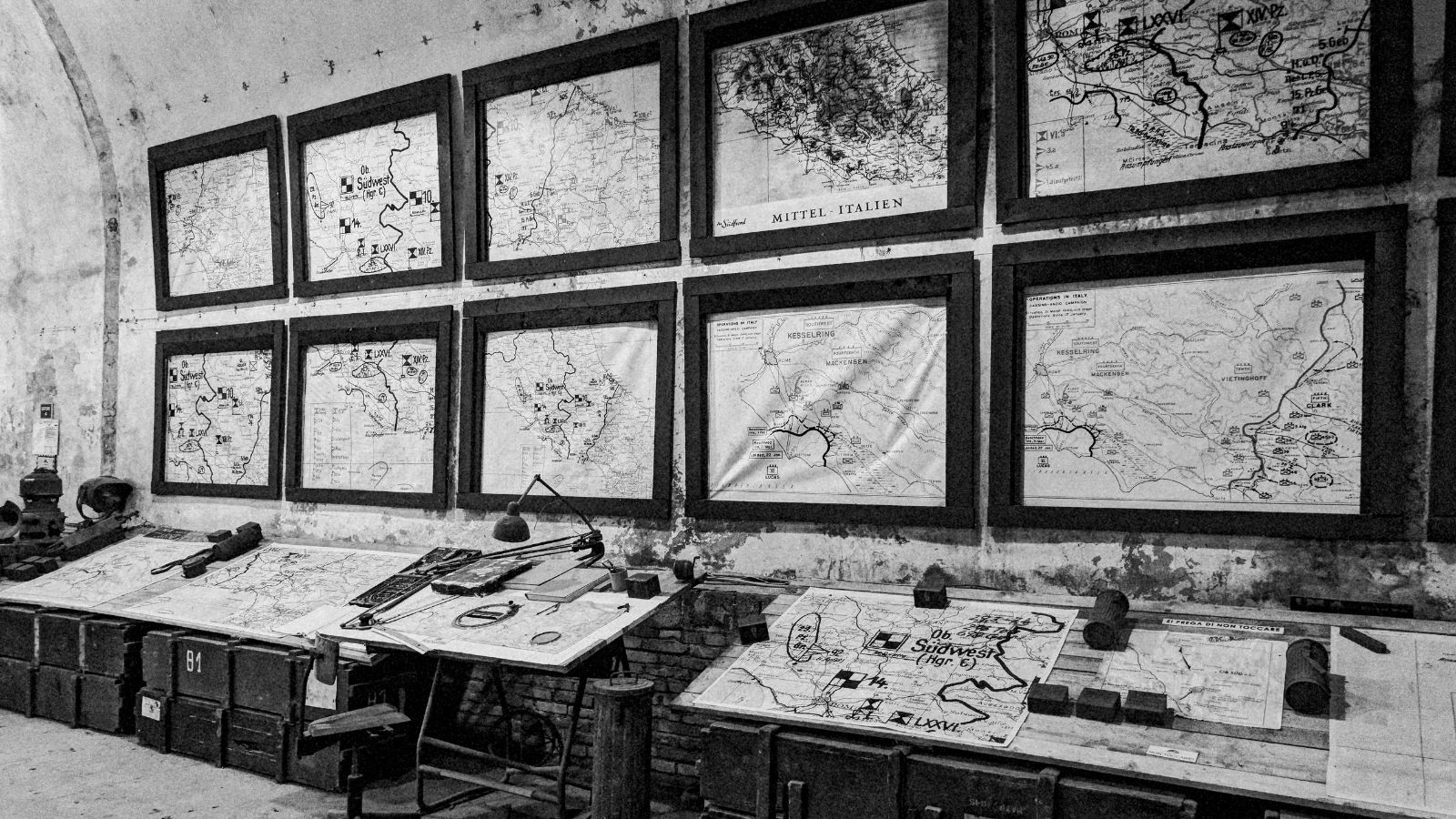
Following Italy’s surrender on 8 September 1943, the underground shelter was occupied by German Wehrmacht troops under Field Marshal Albert Kesselring, who established the Supreme Command for Southern Europe (Oberkommando der Sud West – Hgr. C) at Mount Soratte to direct all military operations in the Mediterranean region.
The German High Command operated undisturbed until 12 May 1944, when Mount Soratte came under heavy bombardment by Anglo-American forces.
Before abandoning the area in early June, Kesselring ordered the entire underground complex to be mined and set on fire, leaving nothing of use to the advancing enemy forces.
The Construction of the Nuclear Fallout Shelter
1963 - 1967
For years after the withdrawal of German troops, the underground complex remained abandoned. It was not until 1963, during the Cold War, that a section of the existing tunnels was converted, under the auspices of NATO, into a nuclear fallout shelter designed to accommodate the Italian government and the President of the Republic in the event of a thermonuclear attack and widespread devastation in the capital.
Construction work, which was only partially completed, continued until 1967, when it was abruptly halted for reasons that remain uncertain.
From the 1970s to the Present Day
1972 - 2026
From the silence of the Cold War years to its cultural revival: today, thanks to the association responsible for its preservation, Bunker Soratte is a place of remembrance, research, and discovery, open to visitors through guided tours and rides aboard the train.